François Boch founded a pottery in Audun-le-Tiche in Lorraine in around 1749. Approximately 36 years later, Nicholas Villeroy did the same in Frauenberg. In order to compete successfully with British imports, Villeroy and Boch merged in 1836. In 1900, Villeroy and Boch employed 1,000 workers.
The company is famous worldwide for innovative designs of co-ordinated tableware, glassware, cutlery, and accessories. In 1748 iron founder François Boch began manufacturing ceramic tableware in the village of Audun-le-Tiche. Because his goods were simple and of high quality, they became well known in a relatively short period of time. By 1767 Boch and his brothers founded another factory under the name of Jean-François Boch et Frères. It was located in Septfontaines (Seven Springs).
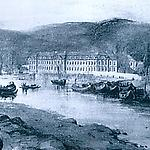
In 1789, with the demand for ceramics growing, Nicolas Villeroy set up a rival factory in Vaudrevange (today called Wallerfangen) on the River Saar. He developed advanced copper plate printing techniques that made serial production cost-effective and used it successfully for several decades. Meanwhile, in 1809, Boch bought the former Benedictine abbey in Mettlach on the River Saar. There he set up an extensively mechanized system for tableware production.
In order to survive on the European market the two former rivals Jean-François Boch and Nicolas Villeroy merged to form one business enterprise. In 1836 the Villeroy and Boch company was founded and soon started its rise to European market leadership.
From 1846 onwards Villeroy and Boch supplied tableware and decorative objects to all areas of Germany. By the year 1850, full range production of high-quality bone china and marble-like parian earthenware had been established, followed by multi-color pattern printing for decoration purposes; the company now sells in all European markets and has also established a foothold in the North and South American markets.
Highly specialized factories proved extremely promising and around 1882 the main focus of the Mettlach factory was the production of washing vessels which were used by people from all walks of life. Production of normal earthenware and majolica items was distributed to other facilities, for example the Villeroy & Boch, Niederlassung Schramberg which existed between 1883 and 1912; gradually however all basins and jugs were pushed aside to make room for ceramic sanitary ware as we know it today. In 1899 the large-scale production of ceramic sanitary ware like bathtubs, sinks and WCs in a new type of material similar to pipe-clay started at the works in Merzig and shortly afterwards, the revolutionary slip-casting process followed, drastically reducing production costs and making bathroom equipment affordable for everyone.
As always, 'Villeroy & Boch' showed perfect timing and the success achieved was quite impressive even when compared with todays standards. Always on the lookout for new inspiration, revolutionary new ideas like that of the Bauhaus movement were taken up by 'Villeroy & Boch' during 1930 and the style reflected in the entire product range. At that time, 'Villeroy & Boch' employed around 10,000 people but the Recession took its toll and by 1931 the factory in Bonn and the 'Steingutfabrik Wallerfangen' (1790-1931) had to be closed. After 1935, the limited corporation was dissolved and all factories were treated as single firms with a general office in Mettlach.
Today, what started off as a small venture today is the largest and most advanced multi-layer manufacturer, producing many different items including actual kitchen sinks.