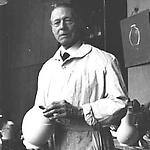
Born in 1854 in Brussels to English parents, Alfred William Finch went on to become a pioneer of the Arts and Crafts movement in Finland. He studied painting at the Académie Royale des Beaux-Art in Brussels and in 1883 became a founding member of Les XX, an avant-garde group of twenty Belgian, painters, designers and sculptors, who challenged the prevailing artistic standards and promoted new developments throughout Europe. In the late 1880's, inspired by the divisionist painting technique of George Seurat and Paul Signac, he began to experiment in pointillism. The year 1890 marked his departure from painting, when he turned with great enthusiasm to the study of ceramics. He worked as a ceramics decorator for Boch Fréres Keramis at La Louviére and in 1896, he began to experiment with glazed pottery in his studio at Forges-Chimay. He exhibited at the 1897 Brussels International Exposition, where his work caught the eye of Count Louis Sparre, who invited him to Finland to work as the artistic director of the ceramics department of the Iris Works. Drawing inspiration from the designs of William Morris as well as Japanese ceramics, he created utilitarian vessels of Finnish red clay, and decorated them with colorful glazes. He often used austere sgraffito decoration to contrast with the simplicity of his forms.
Finch played a huge role in bringing the ideas and aesthetics of the Arts and Crafts movement to Finland. He exhibited his ceramics for the Iris Works at the Paris Exposition of 1900. The Iris Works closed in 1902, after just five years of production. Despite the short period of activity, the Iris Works built the foundation for modern Finnish ceramic art, through its radical and influential designs.
After the factory's closure, Finch became the head of the ceramics department at the School of Arts and Crafts in Helsinki, thus maintaining his strong influence on Finnish ceramics and design, by working directly with the new generation of artists.